
The Smallest of Miracles
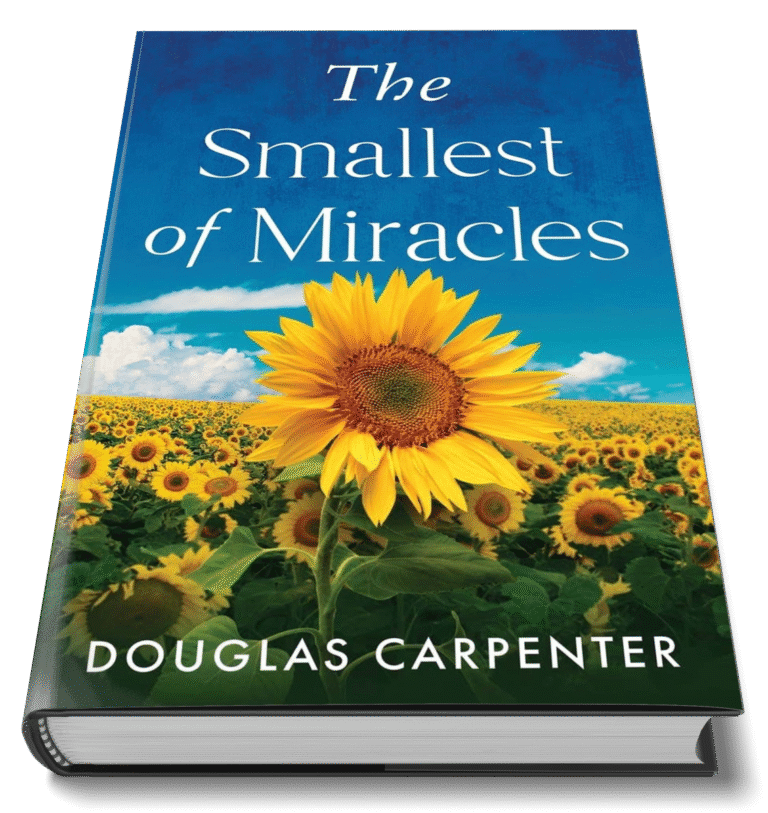
Life Changes at the Smallest Forks in the Road
A decision to speak or remain silent. To hurt or protect. To forgive or hold on. To walk away or stay. To offer compassion when cruelty would be easier.
The Smallest of Miracles follows those seemingly ordinary choices across a lifetime, revealing how one decision can quietly influence another until an entire life has taken shape.
That is very close to the philosophical foundation Douglas establishes in the Preface, where he contrasts memorable milestones with the smaller decisions that actually put a life on its course. The Smallest Of Miracles
A Story That Looks at Life Through a Different Prism
Identity
Belonging
Power
Secrets
Compassion
Forgiveness
Faith
Choice
— Our Sory
He Came Back to Save His Old School.
At forty-nine, Ted Carrington returns to the elementary school he attended as a child.
The school is on the edge of financial collapse, and Ted has the wealth to save it. To those waiting for him, he appears to be a remarkably generous former student.
But Ted hasn’t returned simply to write a check.
Behind his quiet smile is a man who has spent decades mastering information, influence, and the ability to understand what people would rather keep hidden. Waiting for him are three administrators, each carrying secrets of their own.
They think they are meeting a benefactor.
Ted knows differently.
What begins as a meeting about the school’s future becomes a journey through Ted’s past—and through the decisions, wounds, friendships, betrayals, acts of cruelty, and unexpected moments of compassion that made him who he is.
The manuscript establishes this tension immediately: Ted’s supposed purpose is rescuing the bankrupt school, while his actual intentions involve power, influence, and three carefully prepared files on the people he is about to meet. The Smallest Of Miracles


Every Life Begins Somewhere
Before the wealth. Before the power. Before the school.
There was a premature infant lying in a Toronto hospital with no family beside him and one devastating word where his name should have been:
Against the odds, the child survives. Eventually, Joseph and Annette Carrington adopt him. But becoming someone’s son requires more than paperwork.
One frightening moment beside a swimming pool finally allows the young Ted to recognize something he has struggled to understand: this man genuinely loves him.
In that small moment, “Abandoned” becomes Theodore Carrington. The Smallest Of Miracles
This would be a beautiful website section because it introduces the “small miracle” idea without revealing the novel’s later twists.
One Life. Countless Choices.
Who am I?
Ted’s earliest years begin with abandonment, adoption, belonging, and the complicated discovery of what it means to be someone’s son.
His childhood becomes a search for identity—and for evidence that he matters.
Where do I fit?
At school, Ted struggles with friendship, rejection, social expectations, bullying, insecurity, and being perceived as different.
He learns early that appearing “fine” and actually being fine are very different things.
What happens when the powerless discover leverage?
Intelligence gives Ted something childhood often denied him: control.
Observation becomes strategy. Information becomes influence. The child who once struggled to belong begins learning how easily people can be manipulated.
How long can one decision follow us?
Cruelty, betrayal, secrets, prejudice, friendship, compassion, and forgiveness begin accumulating.
Choices that once seemed insignificant refuse to stay in the past.
Can the past be understood without excusing it?
As Ted’s story unfolds, people who once seemed easy to judge become more complicated.
Pain explains behavior without necessarily absolving it, while compassion begins appearing in unexpected places.
Are we defined by what happened—or what we do next?
Can someone genuinely change?
What do we leave behind?
In the end, success is measured by more than money, influence, or achievement.
The smallest act of kindness, courage, forgiveness, or acceptance may travel further through another person’s life than we will ever know.
This progression is much more faithful to the actual book. Even the table of contents moves deliberately through concepts such as Responsibility, Power, Compassion, Reconciliation, Forgiveness, Choices, Salvation, Grace, Faith, Belonging, Judgment, Legacy, Friendship, Fate, and Rebirth. The Smallest Of Miracles
Some things are worth planting again.
As a child, Ted loves sunflowers.
Bright, oversized, imperfect, and impossible to ignore, they represent everything he sees as beautiful in a garden.
His mother sees them differently.
Every spring, Ted plants them.
Every year, they disappear.
And every year, he tries again.
What begins as an ordinary childhood battle over a garden becomes something more—a quiet reflection of persistence, attachment, memory, and the things we continue reaching for even after disappointment.
The manuscript specifically describes Ted repeatedly planting mammoth sunflowers while his mother repeatedly removes them, making the flower a genuine story element that can become a recurring visual motif throughout the website.
Childhood Ends. Its Influence Doesn't.
Ted’s childhood does not remain neatly contained in the past.
The friendships he made, the people he hurt, the humiliation he experienced, the
compassion unexpectedly shown to him, and the choices he made all become pieces
of the adult he eventually becomes.
Decades later, success cannot erase those experiences.
Instead, Ted returns to where many of them began.
To confront them.
What Readers Are Saying
-
"Excellent Read!" — Loretta Morris | Verified Purchase
"This book is excellent, well written, and engaging. Anyone who attended Catholic school will find moments they can relate to throughout the story. Douglas Carpenter creates an absorbing reading experience filled with memorable situations and characters. An awesome read that kept me interested and connected to the story."
Read more -
"Wonderful" — MICHIGAN
"A wonderful story about how a person can move from a self-absorbed, all-business mentality toward becoming more caring and compassionate through connections with others. It also explores how secrets kept for years can influence a person's journey and ultimately change the direction and outcome of a life."
Read more -
"Full of Wisdom" — Janet Walton | Verified Purchase
"The Smallest of Miracles offers encouragement and hope while exploring identity, belonging, and worth. The story reminds readers that our lives are shaped by everyday choices and encourages compassion, forgiveness, and reflection. It is well written, easy to read, and filled with ideas that stay with you."
Read more -
"A Powerful Read" — Brittany Butler | Verified Purchase
"The Smallest of Miracles was an intriguing and powerful read that surprised me in many ways. Ted Carrington grows into a wealthy man who helps others in ways that make you reflect on your own life, choices, and relationships. I definitely recommend this thoughtful and memorable book."
Read more -
"A Great Read!" — Jean Davis | Verified Purchase
"I enjoyed this book tremendously. It brought back memories of my own Catholic grade-school experience and made the setting feel especially familiar and enjoyable. I loved reading about the children, nuns, and priest, and the school atmosphere gave the story a wonderful sense of nostalgia and personality."
Read more -
"Heartfelt and Reflective" — Patricia | Verified Purchase
"The Smallest of Miracles is a psychological and reflective novel that encourages us to look inward and think about how we can improve ourselves. The story is heartfelt, inspiring, and thought-provoking. Douglas Carpenter is a wonderful storyteller who creates a story with meaningful ideas that stay with the reader."
Read more
Discover The Smallest of Miracles
A psychologically rich coming-of-age story about the choices that wound us, the people who shape us, and the possibility that even the smallest act can alter the course of a life.
23 Amazon Customer Reviews

Stories About the Moments That Define Us
Life’s greatest transformations rarely begin with grand gestures—but with the smallest of miracles.
In The Smallest of Miracles, Douglas Carpenter explores the decisions made in life’s quiet margins: the choices that wound, heal, divide, reconnect, and ultimately define us.
Through Ted Carrington’s journey from an abandoned infant to a man of extraordinary wealth and influence, Carpenter examines the invisible intersections of faith, fate, forgiveness, identity, and human connection.
His story asks readers to consider a deceptively simple idea:
Stay Connected With Douglas
articles, behind-the-story insights, and future releases.
More Than Entertainment
The author’s Preface adds an important dimension that I think the website should capture.
Douglas compares life to a symphony: we reach our greatest potential when the different
“instruments” of life work together. He then explains that the story is intended not only to
entertainbut also to encourage readers to reflect and “fine-tune” those instruments in
their own lives. The Smallest Of Miracles
For the website, I would turn that into:
Read the Story. Then Look at Your Own.
The Smallest of Miracles is fiction with something larger beneath its story.
Through flawed people, difficult choices, unexpected kindness, mistakes, consequences, and
second chances, it invites readers to reflect on the seemingly small decisions shaping their own lives.
Sometimes changing the destination begins with changing the next choice.
Explore the Story Beyond the Book

A Fiction Book About Childhood Experiences That Shape Adulthood

A Fiction Book About Success That Cannot Erase the Past

Why Sunflowers Matter in The Smallest of Miracles
What If the Smallest Moment
Changes Everything?
A child without a name.
A friendship formed.
A cruel word spoken.
An unexpected act of compassion.
A secret carried for decades.
A second chance offered.
Individually, they may seem small.
Together, they can shape an entire life.
THE SMALLEST OF MIRACLES
Douglas Carpenter